

Assessment of Values of Natural, Cultural Landscape and Cultural Heritage
The evaluation of the Mastorochoria heritage is based on natural configuration and human activity, which become significant methodological tools ‘to bridge the gap between parts and wholes, traces and entities, the values of a monument to the reality of the monument itself’ (Ganiatsas 2011b). This process aims to assess the Mastorochoria heritage for the collective memory of the society as well as for the economic and territorial development by evaluating its intangible and tangible traits, by defining its universality, integrating all levels (local, national, global), and by considering the varied and different apprehensions and experiences connected to the place (Dümke & Gnedovsky 2013; COE 2008:27-28; COE 2002; CEO 2000:3). The art manager M. Torre has performed an analysis of various systems related to value typology. Among them, the Burra Charter typology of cultural values is considered the most suitable for application. The proposed aesthetic, historical, scientific, social, economic set of values and the additional ecological value fits the large-scale physiognomy of Mastorochoria and the holistic approach of the MaNet Project (Torre 2002:9-10).
Values of Natural Environment and Cultural Landscape
Aesthetic Value
The Mastorochoria territory is an outstanding natural mosaic of high aesthetic that is representative of the Greek and Balkan mountains. The natural environment has great aesthetic value as an inspiration for the creation of works of art and as a source for different crafts. The works of painters and woodcarvers with rich floral and animal decoration is a characteristic example. The masterpieces of craftsmen of Mastorochoria are tangible evidence of this interrelation. The stone structures of the erected environment have become the landmarks of the Mastorochoria territory.
Historic Value
The qualitative tangible and intangible traits of the Mastorochoria cultural heritage tell the story of the irreplaceable cultural activity of a civilization that once developed and thrived under certain unique political, economic, historical, social and natural conditions. The interrelation of the natural environment and the cultural landscape and heritage reflects the transition from the pre-industrial to the industrial era in Greece.
Scientific Value
The territory is an open-air museum for the public but also an experimental ensemble for observation for wide range of natural scientists. The territory is an outstanding ensemble of diverse flora and fauna. The local knowledge that the cultural landscape exudes reflects a way of thinking and living in and with nature at all stages of human development.
Social Value
The territory has profound social value for the harmonious interaction between humans and the natural environment as a formula for people’s welfare. The current and prospective, direct and indirect use of natural resources is a guarantee for long-term social well-being. Biological diversity has contributed to the formation of the social patterns of living in nature and within nature. The natural environment influences and defines indirectly the mentality of the inhabitants of the territory. The well-preserved mountainous cultural landscape and architecture constitutes a fundamental link in the chain of socioeconomic and artistic development of Mastorochoria. The harmonious coexistence of the natural environment and cultural landscape and heritage uniquely commemorates the creative and innovative spirit of craftsmen. The cultural tangible and intangible rudiments are the key witnesses of the direct and indirect multicultural coexistence. The Mountains and the Rivers became the symbols of unity as places of cultural dialogue between different societies in local and supra-local level.
Economic Value
The generous biological and genetic prosperity in combination with innovative agricultural technologies create a promising framework for the cultivation of several ‘dietary’ plants in an organic and sustainable way, which contributes to smart, inclusive and sustainable growth. The indirect use of the territory is an indispensable component of harmonious coexistence between humans and nature. Hence, it provides a prerequisite for future measures in terms of economic growth. The unexplored encoded information in the various components of cultural heritage has generates value for fund.
Ecological Value
The pristine natural areas with their abundant and varied flora and fauna aref exceptional ecological value. The intact natural sites close to the settlements reflect the strong ties between human and nature, which fostered deep ecological awareness and a profound interrelation. The ‘young’ forests are of particular ecological value as a unique and rare hybrid that was created exclusively by the seminal contribution of both human and nature.
Statement of Significance, Authenticity, Integrity and Protection & Management of Values
Statement of Significance
The Mastorochoria territory stands out for its diversity and distinctive cultural identity. The perpetual fermentation between nature and humans formed exceptional natural and cultural interconnections that are impossible to separate. The absence of even one value in fact leads to the absence of much more. Thus, the significance of Mastorochoria is tied to the strong and unbreakable network of cultural and natural values the craftsmanship as the core. The dynamism the different but interrelated elements divert into a solid evidence at all levels creates potentialities for development and attributes competitiveness in the territory. This treasured polysemy of Mastorochoria enables the MaNet Project to endow its valuable context with an indispensable and vital character through a holistic and integrated approach.
Authenticity
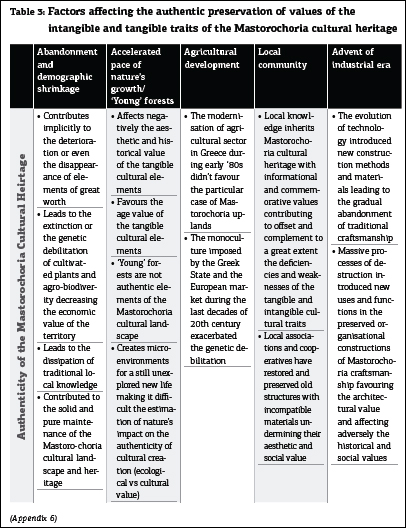
Indisputably, the Mastorochoria cultural heritage is the authentic result of a dynamic and lasting interaction between natural and human processes in the territory. Scientific research, analyses and examinations, spoken discourse of local memories and bibliographic resources, tangible and intangible evidences contribute to the verification of the Mastorochoria authentic cultural context. Despite the fact that the majority of cultural elements are partly preserved (Table 3), they acquire ‘multi-interpretability’, and create ‘potential field of interrelated cultural content and values, which express the unity of [the] particular heritage’ (Ganiatsas 1996:105). The structures may have been aesthetically tainted, but their substantial base in combination with their rich intangible context is still able to to tell the story of the past.
Integrity
The continuous inhabitation of Epirus since prehistoric times made both the cultural heritage and landscape an integral part of the natural environment and vise versa. For this reason nature and human are interactive forces, where one affects the integrity of the other (Table 4).
|
Table 4 Natural HeritageThe inaccessible areas of its mountainous geomorphology along with the ecological consciousness of the Mastorochoria communities encouraged the preservation of forested areas as undamaged and virgin places. Logging activity is now practiced in only a few villages (Langada, Kefalochori). The depopulation of the villages benefits the protection, preservation, even the expanding of some animal species. Regeneration of vegetation in anthropogenic environments related to animal husbandry and domestic animals breeding poison the protected and endangered species of bear. Illegal hunting and fishing have increasingly become an acute threat for the majority of wild fauna in Mastorochoria. Cultural Heritage The desolation of the Mastorochoria villages and the abandonment of traditional economic activities resulted in the ‘decomposition’ of the cultural heritage. The forest regeneration covers and deteriorates significant structural elements of Mastorochoria craftsmanship. Even the old structures, which are usable, bearing signs of dereliction. The elements of the cultural heritage that are located in the villages are better preserved. The sacred natural sites are affected by new diseases, which jeopardize several species of holy trees and by lack of ecological awareness and vandalism. |
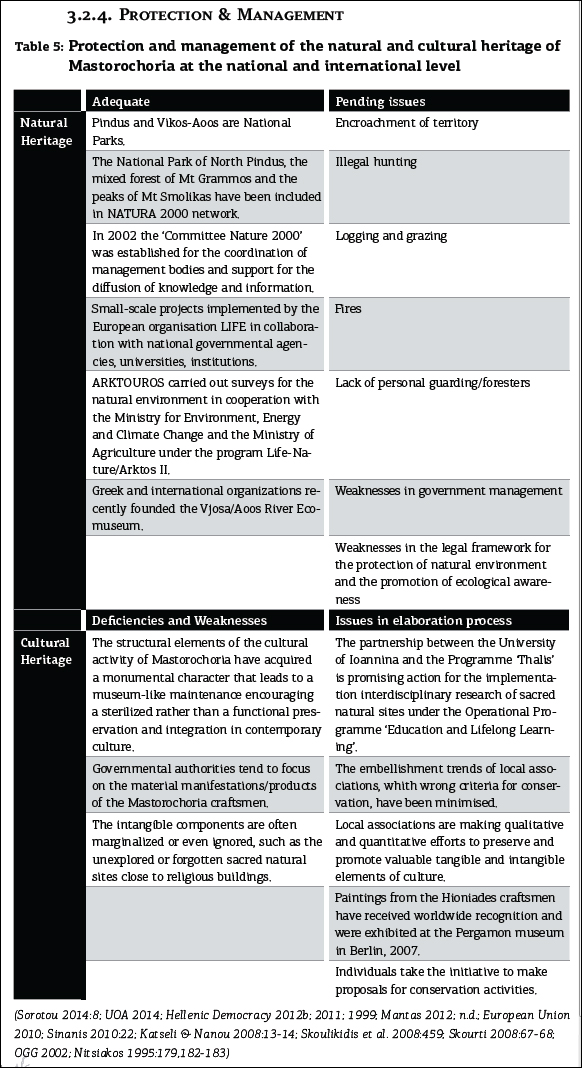
Protection & Management
Conflicts and Synergies of Values
Life, routes and monuments created by Mastorochoria craftsmen formed an ensemble of values. The ‘characterization and assessment of [these] values are critical and particularly difficult because they require potentially many different methods and many collaborating professionals’. Thus, as Randall Mason suggests, ‘collaboration across disciplines is essential’ (2006:39-40). Moreover, an analysis in this framework represents the fundamental methodology of the MaNet Strategic Plan. Hence, in order to design the Strategic Plan with a holistic approach, a ‘values-centred’7 initial identification has been conducted. However, the culture that formed around the craftsmen in the area of Mastorochoria -as a ‘dynamic and changing’ notion- contained contradictions, shifts and conflicts. Consequently, the values of this territory are a combination of conflicts and synergies. Accordingly, values are often mutually opposed in synchronic, diachronic, local and/or supra-local levels (Nitsiakos 2003:73,82,168-172). In order to ‘assert heritage values in the same arena as contemporary values’ and plan projects that will benefit and protect the social fabric, it is of great importance to prioritize the weight of values in a tailor made flexible model, taking into account the particularities of every project individually. This innovative approach excludes generalizations and a priori evaluations. Besides, in his renowned article ‘The Modern Cult of Monuments: Its Character and Its Origin’ in Oppositions 25 Alois Riegl has already identified conflicts of values that occur on issues of monument preservation, which can be resolved only by balancing the needs of a monument and the society that includes it at a time (1982:21-51). According to this approach, Paul Drury from the perspective of a Chairman of the Steering Committee for Cultural Heritage (CDPAT) stresses that ‘[t]here is a particular need to develop an understanding that heritage is constantly being created and destroyed; the process is a negotiation between past, present and future’. Therefore, it is essential to draw on concepts that ‘shift the emphasis from preventing change to managing change based on knowledge’ (2002:13). However, the MaNet Project also has to overcome the complex discussion on which set of values is objectively important. From universal to local and even to individual assessment of values, MaNet must manage conflicts in a dialectically constructive way. In this sense, the project adopts the model of co-existence and ‘democracy whereby differences are accepted’. The outcome is a synthesis8 of values. This is realized rather as an organized structure and prioritization ‘according to a particular intention to mediate between’ values of the past and the present, even the future, needs, than a list of existing values in a vacuum, isolated from their context. Moreover, the challenge is to provide the ground in which various conflicting or consistent values coexist valorising all the aspects of the cultural heritage harmonically (Ganiatsas 2011b:22-25; COE 2008:47; Avrami, Mason & Torre 2000:8).
Focusing on a holistic framework, the MaNet Project adopts the relevant theories and integrates them with the innovative regional intelligence concept. Here, tailor-made in-depth diagnosis and evaluation procedures are designed as a dynamic equilibrium. Crucially, all the researches and analyses represent ‘full knowledge of the values of a site’, and underscore the importance of the research agenda, local involvement, and the monitoring mechanisms (COPTA 2011:9-10; Mason 2006:30-40; Nitsiakos 2003:73,82,168-172).
7 As a methodology, values-centred planning provides three main advantages that are in total accordance with the MaNet strategic framework. First, it ‘enables the holistic understanding of sites’. Second, it ‘leads to an acknowledgement and inclusion of a greater range of stakeholders by accounting for all the values of a site’ and, third, it supports ‘the long view of stewardship’ (Mason 2006:34).
8 Synthesis is considered here, in line with professor Vassilis Ganiatsas arguments, ‘never [to be] neutral and absolute, but [as] an intentional act, a creative projection of an intended whole picture out of fragmented parts and traces (Ganiatsas 2011a:9; 2011b:24).