Tracing the Routes of Traditional Crafts
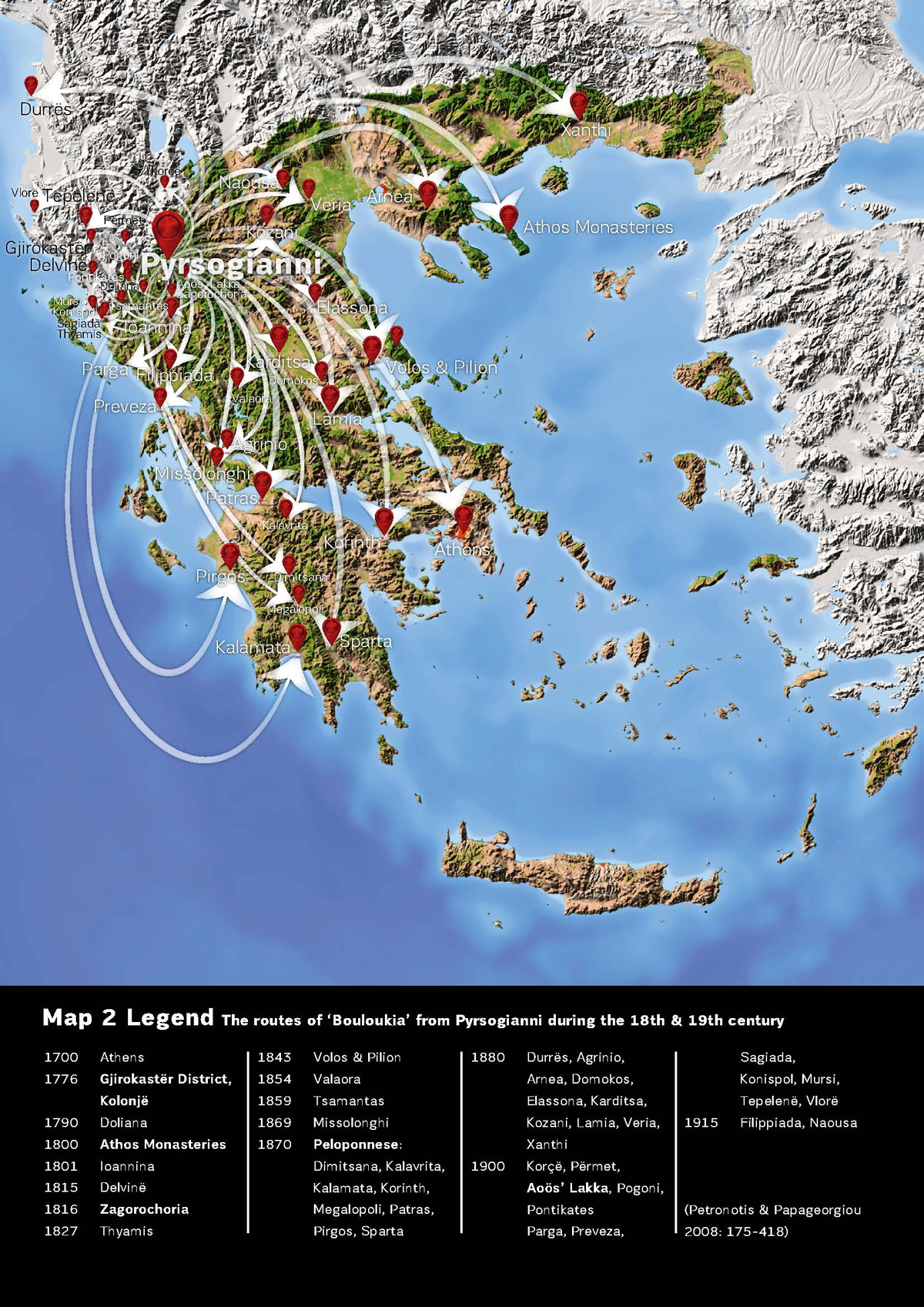
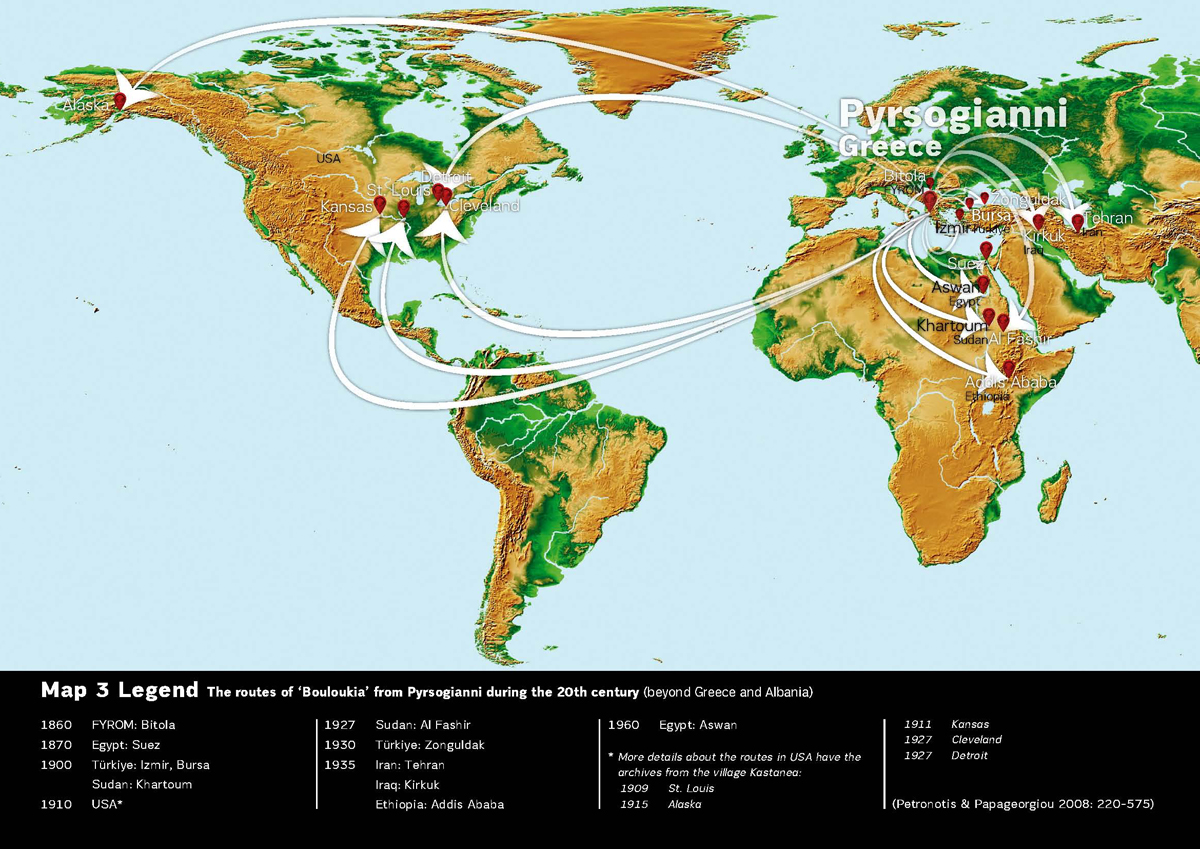
The Historical and Landscape Analysis have already underlined the fact that the area of the Sarantaporos glade was of extreme importance since the first organized communities inhabited the slopes of Smolikas and Grammos. This passage, that connected the Ionian and the Aegean seas and facilitated the communication and the commercial activities when Epirus was a crucial crossroad at the heart of different empires, is engraved in multiple itineraries. The road networks of the past are almost invisible nowadays and only ruins and archival references speak of their existence. The routes became ‘marginal compared to the most frequented’ and modern roads of the recent infrastructures. However, these networks were the basic itineraries of the ‘Bouloukia’ as the most appropriate means of diffusion for their marvellous art throughout the world. ‘The routes of craftsmen are of extreme importance because they outline both the contribution of the local techniques to the folklore art and the influences of other cultures to their art’ (Sorotou 2014: 92; Papageorgiou 2000:16). Moreover, the study, the research and the emphasis on these routes within the context of the MaNet Strategic Plan, ‘is an indispensable tool to understanding the traditional system’, while at the same time pinpoints locations with significant strategic value regarding the network (Lecha-Marzo 2012:17,144). In order to build ‘the correct perception of spatial reality in its growth and changes’ about the scale and the dimention of the significant craftsmen culture, MaNet recorded the routes of the ‘Bouloukia’ of the Pyrsogianni’s masonry craftsmen (Map 2,3). As one of the best representatives for masonry crafts, Pyrsogianni is still one of the oldest, though very well preserved and active18, village of the Mastorochoria. These characteristics reinforced the efforts of locals who act through the ‘Progressive Union of Pyrsogianni’ to collect precious data and artefacts. The maps of the routes of ‘Bouloukia’ from Pyrsogianni ‘constitute a way of generating knowledge’ and provide a clear image of the magnitude of their importance in local and global level (Papaioannou 2008:207; Principe 2002:28; Torre 2002:20).
Today, the life of the craftsmen and the achievements of this local knowledge, that have always respected nature and human need, are the legacy, the foundation, the common thread that promotes the local communities to a smart, sustainable and inclusive growth following and even leading the Hellenic, European and Universal vision for the
future (COPTA 2011:5).